Each year, the state of Florida faces the risk of hurricanes. And sadly, we’re no stranger to them. The Northwest Panhandle and the southeast coast, including Miami, Cape Canaveral, and Fernandina Beach, see more storms per decade than almost anywhere else in the country. By contrast, inland central and northeastern Florida historically experiences fewer direct impacts, but no area is truly immune. Of all weather disasters recorded in U.S. history, tropical cyclones have caused the most deaths and destruction, and recent storms like Hurricane Helene in 2024 highlight just how devastating one system can be.
But here’s the thing. Florida, especially central and southern Florida, is a great place to live and work. And so for businesses, hurricane season is not a matter of if but when. But preparing your organization means more than stocking supplies. It requires dependable communication that keeps employees connected when cell networks and email fail.
In this article, we’ll look at how your business can prepare for hurricane season and why two-way radios must be part of your disaster readiness plan.
The Cost of Hurricanes in Florida and Beyond
Of all recorded weather disasters in U.S. history, tropical cyclones have caused the most deaths and destruction. Florida has long been in the center of that story, with its geography leaving both coastal and inland communities vulnerable to devastating winds, storm surge, and flooding.
Hurricane Helene, which made landfall near Perry, Florida, on September 26, 2024, serves as a sobering example. With sustained winds of 140 miles per hour, Helene became the strongest hurricane on record to strike the Big Bend region and the third to impact that area in just over a year. Its reach extended far beyond Florida, causing catastrophic flooding in western North Carolina, as well as severe damage in Virginia, Tennessee, and Georgia.
Among the deadliest U.S. hurricanes since Maria in 2017 and Katrina in 2005, Helene claimed at least 227 lives. With initial damage estimates exceeding $79.6 billion, it also currently holds the title as one of the costliest hurricanes in U.S. history. For Florida businesses, these numbers simply show the importance of preparation, not just to safeguard property, but to protect employees and maintain communication during and after the storm.
Business Continuity During Hurricane Season
Preparing for hurricane season isn’t only about getting buildings reinforced or stocking emergency supplies. It’s about keeping operations running when normal systems fail. Storms bring challenges that can quickly interrupt business continuity and threaten employee safety. Without strong communication, even the best-laid emergency plans can unravel.
This is where the concept of climate resilience comes in. Climate resilience is about being ready for and bouncing back from weather surprises. For businesses, that means having the tools to stay connected and minimize downtime even as storms grow stronger and less predictable. With the weather changing fast, building resilience is no longer optional—it’s necessary.
Common risks Florida businesses face during hurricanes include:
- Power outages: Extended blackouts can last for days, cutting access to phones, email, and critical systems.
- Cellular network failures: Overloaded towers or damaged infrastructure often make mobile phones unreliable.
- Flooding and property damage: Facilities may become unsafe or inaccessible, forcing teams to relocate operations.
- Supply chain disruptions: Deliveries may be delayed, leaving businesses short on essential materials.
- Employee safety concerns: Staff need a dependable way to communicate before, during, and after the storm.
By planning ahead with climate resilience in mind, businesses can reduce downtime, keep employees safe, and maintain control during unpredictable conditions. This is where two-way radios play a role in such a big way. These devices provide immediate, reliable communication when other systems are down. We’ll talk more about this in the next section.
Why Two-Way Radios Outperform Other Tools
Imagine trying to rely on something like email when disaster strikes. Even cell phones won’t help you connect with those that matter. When a hurricane strikes, communication tools are absolutely put up to the test. And believe it or not, many businesses still do rely on email and cell phones. Unfortunately, during disasters, these systems are often the first to fail.
- Cell phones: Networks can become overloaded as thousands of people try to call or text at once. Towers may also be damaged by wind or flooding, leaving entire regions without service. Even when calls go through, the process of dialing and waiting wastes precious seconds in an emergency.
- Email and internet-based tools: Power outages and broadband disruptions can make email completely unreliable. In fast-moving situations, employees don’t have time to check inboxes when urgent instructions are needed.
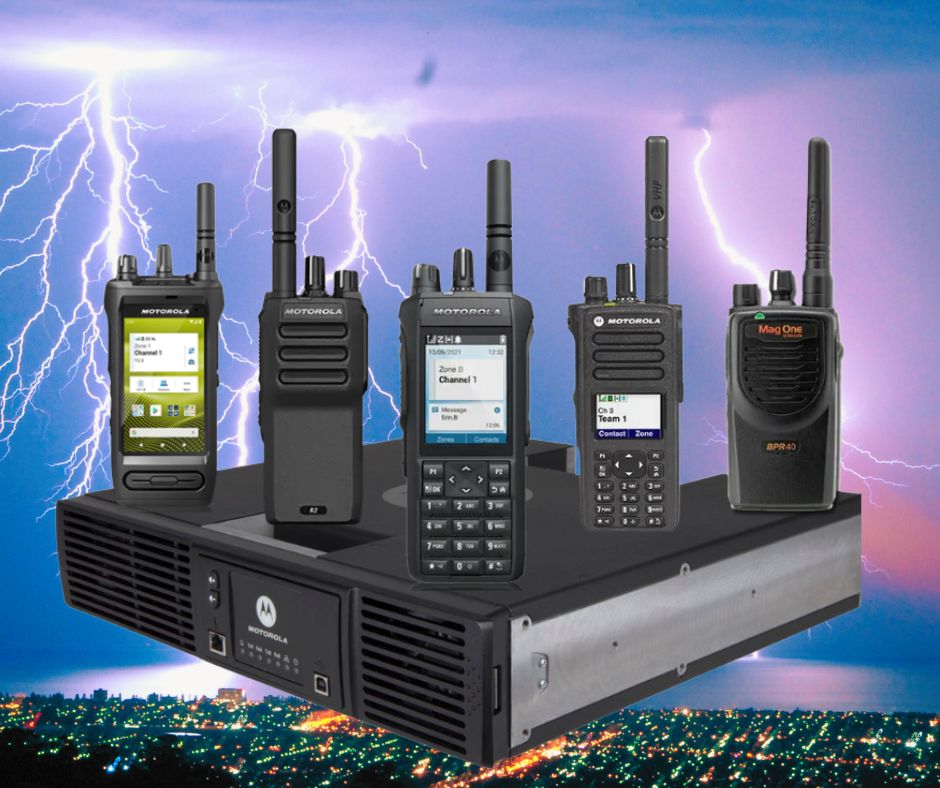
Two-way radios, by contrast, are built for reliability in storm conditions. With push-to-talk capability, users can connect instantly without worrying about call drops or internet outages. Radios allow for one-to-many communication, so teams hear updates at the same time rather than relying on chains of phone calls. Long battery life and rugged construction mean radios keep working even when conditions are rough.
Advantages of Using Radios in Hurricane Preparedness
When the power is out, networks are down, and the pressure is on, two-way radios provide a lifeline that other tools simply can’t match. For businesses preparing in central and southern Florida, radios offer practical features that make them a strong choice during hurricane season.
Here are the advantages you can expect.
- Instant communication: Push-to-talk allows messages to be shared right away, without dialing or waiting.
- Reliable operation during outages: Radios work independently of cellular towers and internet connections.
- Group coordination: One message can be broadcast to an entire team, keeping everyone on the same page.
- Extended battery options: Spare batteries and multi-unit chargers keep radios in use for days if needed.
- Built for challenging conditions: Radios are designed to keep working in the rain, wind, and rough handling common during storms.
- Expandable systems: Larger organizations can pair radios with dispatch consoles for centralized command and faster decision-making.
By incorporating radios into emergency planning, Florida businesses add a dependable communication layer that helps keep teams connected before, during, and after the storm.
Preparing Your Business for Hurricane Season
It may seem like we’re trying to talk you out of opening or managing a business in hurricane-prone areas, but that is not the case at all. These communities remain popular to tourists and vital to the state overall. But preparation is super important in the event of a natural disaster. And preparation is all about being proactive versus reactive.
Of course, as a Motorola channel partner, we’re going to talk a lot about two-way radios. But having two-way radios on hand is only part of the solution. Your business also needs a plan for how to use them before, during, and after a storm. For organizations in central and southern Florida, preparation can make the difference between confusion and coordination.
Here are the steps to take to get radio-ready.
- Audit your communication needs: Identify how many employees require radios, which teams need to stay in constant contact, and where coverage is most critical.
- Set up radio protocols: Assign channels for specific groups (security, facilities, management, etc.) so conversations remain organized.
- Train employees early: Hold short training sessions so staff know how to use radios, switch channels, avoid common two-way radio mistakes, and maintain proper communication etiquette.
- Stock extra accessories: Keep spare batteries, chargers, earpieces, and carrying cases in your emergency kit.
- Pair radios with other supplies: Radios work best alongside flashlights, generators, first aid kits, and non-perishable food stored for emergencies.
- Conduct a practice drill: Test radios before hurricane season to confirm range, battery life, and familiarity among staff.
By preparing ahead of time, businesses create a reliable communication plan that supports both employee safety and operational resilience when storms hit.
Renting vs. Buying Radios for Disaster Preparedness
When preparing for hurricane season, one decision businesses face is whether to rent radios temporarily or invest in owning them long term. Both approaches have merit, and many Florida organizations use a mix of the two depending on their needs.
When renting makes sense:
- Ideal for organizations that don’t rely on radios year-round but want extra communication support during hurricane season.
- A practical choice for seasonal businesses, such as resorts or event venues, that only face heightened communication demands during certain times.
- Lower upfront cost and no responsibility for maintenance, which can be helpful for budget-constrained departments.
When buying makes sense:
- Best for organizations that need radios daily, such as healthcare facilities, schools, logistics providers, and construction companies.
- Ownership allows radios to be customized, programmed, and always available when storms strike.
- Long-term investment that saves money compared to repeated rentals year after year.
Taking a hybrid approach to buying vs. renting two-way radios
Many Florida businesses purchase a core set of radios for everyday operations and rent additional units ahead of hurricane season. This model combines reliability with flexibility, giving organizations the ability to scale communication resources as needed.
The Role of EMCI Wireless
Preparing for hurricane season requires more than just equipment. It takes a partner who understands both the risks and the right communication strategies. That’s where EMCI Wireless can help. With decades of experience serving businesses, public safety agencies, and organizations across Florida, we provide tailored solutions to keep teams connected when the pressure is on.
We specialize in both portable and mobile radios, offering purchase and rental options designed for year-round operations and seasonal emergencies. Whether your team needs handheld units for on-site staff or vehicle-mounted mobile radios for utility crews and first responders, EMCI delivers solutions that support reliable communication in the toughest conditions.
Our services go beyond sales and rentals. We help organizations create two-way radios hurricane preparedness plans, including programming, training, and support so that staff know exactly how to use their radios when a storm strikes. Many businesses also work with us on hybrid solutions, owning a core fleet of radios while renting additional units for peak hurricane season, to balance cost with readiness.
By partnering with our team, Florida businesses gain more than equipment. They gain a trusted ally in building communication resilience during hurricane season and beyond.
Two-Way Radio Hurricane Preparedness with EMCI Wireless
Hurricane season is a reality for businesses across central and southern Florida, and preparation goes beyond stocking supplies. Clear, reliable communication is the foundation of keeping employees safe and operations steady during and after a storm. Cell phones and email often fail when they’re needed most, which is why radios remain a dependable choice.
EMCI Wireless helps organizations design and implement two-way radios hurricane preparedness plans, offering purchase, rental, and hybrid options tailored to your needs. Don’t wait until the next storm is on the radar. Contact EMCI Wireless today to keep your team connected when it matters most.