
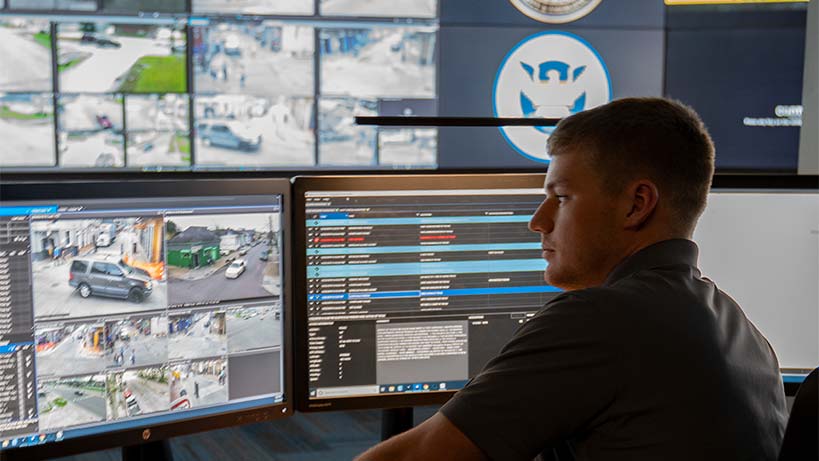
As business owners, you want your business to be safe at all hours. But the thing is, crimes against businesses are on the rise, and this can be especially frustrating when you’re trying to keep your costs down and provide a great service to your customers. In fact, a recent article from the U.S. Chamber of Commerce calls for action to reduce crimes against businesses.
But here’s the thing. Though this effort will likely help, the chances are that you will still need to pursue security on your own. And one of the best ways to deter theft and other crimes is through a security patrol. That said, not all security patrols are the same. In this article, our team here at EMCI Wireless will walk you through not just what a security patrol is, but the different types and how and when to use each.
Understanding the Core Goals of a Security Patrol
We hate to say it like this, but go with us here for a moment. Try to put your head inside the mind of a criminal and think as they do. Imagine making your way to a local business with the intention of stealing some of their packages. Maybe it’s a local restaurant. It could be a local retailer. The type of business doesn’t matter. But what does matter is what you see when you arrive on site.
First, you see some outdoor security cameras posted up in the corners of the parking lot or attached to the building. This discourages you a bit, but you think you simply secure the hood of your sweatshirt to make sure your face is covered, and you decide to continue with your plan. But then, you hear something. Is that someone whistling? It sure is. And you realize the truth. This business has invested in an on-foot security guard who is roaming the premises. At this point, your plan has been thwarted, and this particular business has been saved from whatever wrongdoing you had been considering.
Security patrols help reduce the risk of theft. When used alongside other security measures, you’re setting your business up for fewer theft incidents and a better environment for everyone involved. And that’s exactly the goal of a security patrol: to keep you, your customers, and your business safe.
The 5 Principles of Patrolling
When we talk with our customers about security patrols, we typically cover five unique principles: planning, reconnaissance, security, control, and common sense. Let’s dig into each of those, so you understand how all of these principles help deter crime and theft.
Planning
Every solid security patrol starts with a plan. That means knowing the property, understanding peak hours, identifying problem areas, and setting clear expectations for patrol routes and responsibilities. A well-thought-out plan helps guards stay focused, avoid gaps in coverage, and respond faster when something feels off instead of reacting on the fly.
Reconnaissance
Reconnaissance is all about paying attention. Security patrols aren’t just walking or driving around. They’re observing. Always. Guards should constantly scan their surroundings, notice what’s normal, and spot what doesn’t belong. Small details, like an unfamiliar vehicle or an unlocked door, often signal bigger issues before they turn into real problems.
Security
This principle focuses on protecting the patrol team while they protect the property. Guards need to patrol in ways that limit risk, avoid unnecessary exposure, and maintain awareness of exits, lighting, and blind spots. Staying connected through reliable communication tools such as portable two-way radios can be a super beneficial way to keep those who need to be in the know, both supported and informed.
Control
Control keeps a patrol organized and responsive. Clear leadership, defined reporting procedures, and steady communication help patrol teams stay coordinated, especially across larger properties. When something happens, guards know who to contact, what steps to follow, and how to work together rather than acting independently or creating confusion.
Common Sense
We can’t emphasize this principle of security patrolling enough. Common sense. That’s really what ties all of this together. The thing to remember is that not every situation needs a complicated response. And, to the same degree, not every situation is going to follow a pre-determined checklist.
Good security patrolling is about sound judgment. It’s about knowing when to investigate further, when to call for help, and when to rely on your gut instincts. To sum it up? Experience, awareness, and practical thinking are what typically make the biggest difference.
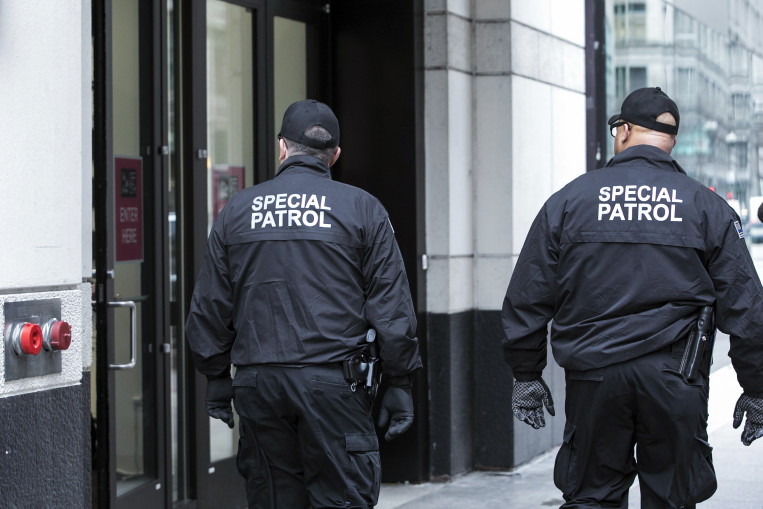
1. Foot Patrols Offer Close-Range Presence and Interaction
Now, let’s talk about the five types of security patrols and when to use each. And it all starts with foot patrols. Remember that example we shared earlier? In that hypothetical situation, the criminal was deterred because of the security guard walking the premises.
Now, we recognize that this statistic we’re about to throw at you is a few years old now. But consider that a study found that there was a 23% reduction in violent crime in the areas where there was evident foot security patrols compared to areas without. That’s a pretty impressive statistic, no matter how old it is. And the thing to understand now is that with modern technology, foot patrols are often also paired with other security measures. This can be a pretty solid way to deter theft.
2. Vehicle Patrols Can Cover Larger Properties
While foot patrols are highly effective, so too are vehicle patrols, especially when they are consistently inconsistent. What we mean by that is that criminals often pay attention to behaviors. If you pay a security company to drive by three times a night at set times, there is a good chance that your would-be thug has been paying attention and knows that. So, they’ll plan to hit you up between those drive-bys.
The best approach to vehicle patrols is sporadic, unpredictable monitoring. So, if you want to help protect the perimeter of your business location, a vehicle patrol, especially one equipped with a MOTOTRBO portable radio, can pay off in a big way.
3. Fixed-Route Patrol Offers Predictable Coverage for Routine Monitoring
This isn’t to say that there isn’t a time or a place for a fixed-route patrol. There is. In fact, when criminals see that you have a fixed-route patrol in place, it’s safe to say that they’ll realize you’ve likely invested in other security measures, too.
So, just what does a fixed-route patrol do? Just as it sounds, these patrols follow a set path on a regular schedule. Guards check in the same areas in the same order each time. This approach works well in environments where routines matter. Hospitals and medical campuses benefit from predictable oversight of entrances and corridors, school administrators, educators, and parents gain reassurance during class hours, and manufacturing facilities rely on consistent checks to monitor equipment, restricted zones, and safety concerns.
4. Randomized Patrols Reduce Predictability
Anyone thinking about committing a crime usually watches first. We see it in movies all the time. Patterns get noticed, routines get mapped out, and timing becomes predictable. That’s why so many business owners decide that randomized patrols are the best approach for their business.
By changing routes and schedules, security teams make it much harder to anticipate their presence. This approach works especially well in parking lots, mixed-use properties, and commercial spaces after hours.
5. Surveillance-Assisted Patrols Combine Technology and Mobility
We have one more type of security patrol to discuss. And this one combines technology and mobility. The tactic is referred to as surveillance-assisted patrol. But what does that really mean?
Simply put, this type of security patrol relies on cameras to serve as extra eyes across a property. When something unusual is spotted on screen, patrol teams can be dispatched immediately. This approach works well for event venues such as stadiums, corporate campuses, and warehouses, where large areas are difficult to monitor on foot or by vehicle alone.
Matching Patrol Types to the Needs of Your Property
At this point, one question remains. How do you decide which patrol type is best for your property? We often ask our clients the following questions to help them decide which path to take.
- How large is your property, and how spread out are the buildings or outdoor areas?
- Which parts of your property are open to the public, and which areas should stay restricted?
- Are your biggest security concerns during business hours, overnight, or both?
- Do certain areas need more frequent monitoring than others based on past issues or traffic?
- Would your property benefit more from consistent coverage or less predictable patrol patterns?
As you answer these questions, it often becomes clear as to the best type of security patrol for your business needs.
How Two-Way Radios Support Modern Security Patrolling
As a Motorola Solutions partner serving southern and central Florida, we’d be remiss not to discuss how two-way radios can enhance your security approach. And we won’t beat around the bush, either. Two-way radios are far more effective than cell phones to communicate information quickly when time matters.
You’ve probably experienced the limitations of cell phones yourself. Calls go to voicemail, screens lock at the wrong time, signals drop inside large buildings, and group coordination turns into a game of phone tag. In security patrolling, that kind of lag can cause confusion or missed details. Two-way radios and radio repeaters remove those barriers and keep teams connected instantly.
Here are just some of the ways that Motorola two-way radios can help your security patrols.
- One-touch communication without dialing or waiting
- Clear group communication across large properties
- Reliable performance indoors and outdoors
- Faster coordination during incidents or emergencies
- Consistent connection for mobile and fixed patrol teams
EMCI Wireless Can Pair the Right Two-Way Radios With Your Security Patrol Approach
Once you’ve identified the best security patrol tactics for your business, we can help you decide on the best approach to cameras, two-way radios, and other technology to round out your approach. And we make it easy for you to get started.
Request a free consultation today. We’re here to help you support the steps necessary to protect your business from today’s criminals.