
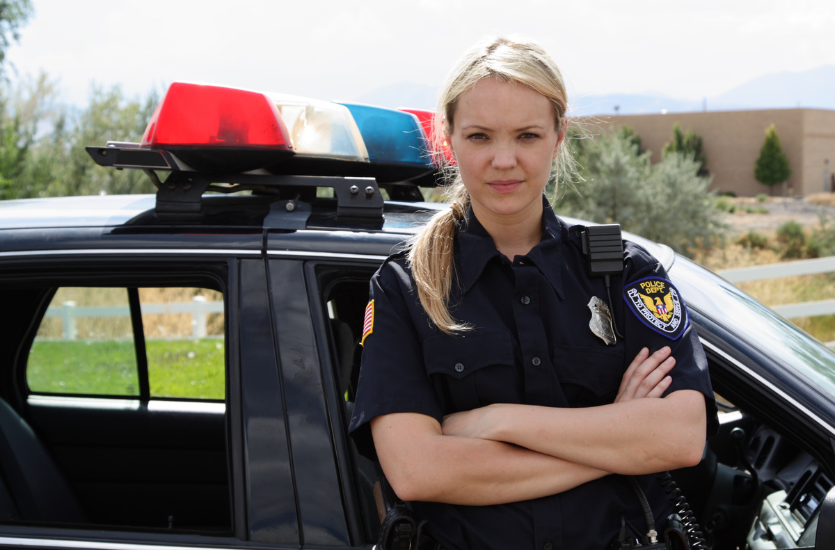
Have you ever wondered about the differences between a security guard vs. a police officer? Interestingly enough, it’s not an uncommon online search phrase. It appears that many people are curious as to the distinction. Perhaps it is someone deciding on their career path. Or maybe, it’s a business owner thinking about the right level of security needed for their business.
The truth is that while one could argue that both police officers and security guards have a mission of “to serve and to protect,” the roles are indeed different. These unique positions require different levels of training, are often tasked with different levels of protection, and one has legal authority, whereas the other does not.
In this article, we’ll explain the differences so that you can decide how to best pursue the necessary protections for your southern or central Florida business.
What is a Security Guard?
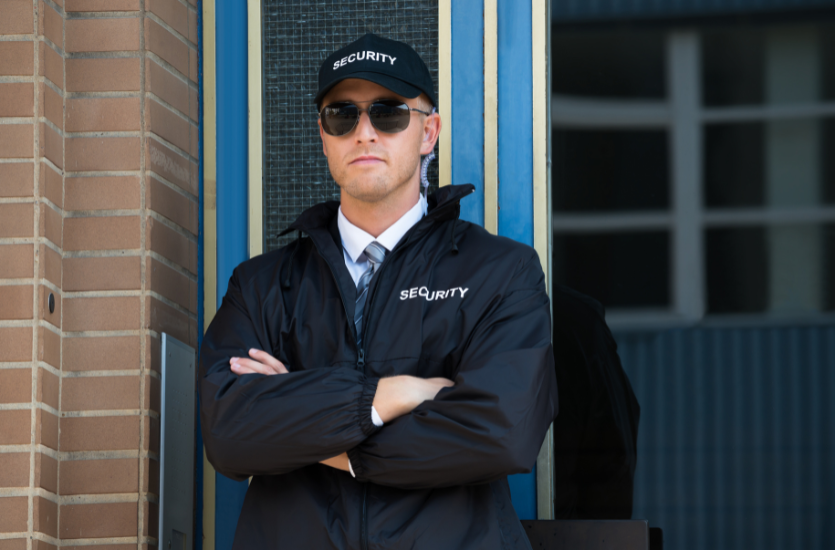
The easiest way to explain the role of a security guard is to say that they have something specific and often tangible to protect. Security guards are often found at places such as your favorite shopping mall, large (or small) corporate office buildings, and even patrolling residential communities (especially gated communities). This all said, remember that even though security guards have the job of providing on-site protection, they are not police officers. Simply stated, security guards do not have the same rights as police officers.
Security guards are typically hired by private businesses, property managers, healthcare facilities, event organizers, or homeowners’ associations. Their presence alone can discourage theft, vandalism, and unauthorized access. In many cases, they serve as the first line of observation if something unusual occurs.
All said, here are the overall responsibilities of a security guard.
- Patrol assigned property on foot or in a vehicle to monitor activity
- Monitor surveillance cameras and alarm systems
- Control access points and verify identification
- Write detailed incident reports for management
- Respond to disturbances and de-escalate conflicts when possible
- Contact local law enforcement when a situation requires police involvement
- Assist employees, residents, or guests during emergencies
When discussing a security guard vs police officer, be sure to recognize that a security guard’s authority is limited to the property they are hired to protect. Their role centers around prevention, visibility, and reporting rather than enforcing criminal law.
What is a Police Officer?
Whereas a security officer has a narrowly defined scope of protection and legal limitations, a police officer is typically tasked with protecting the community at large. Police officers are sworn law enforcement professionals who work for a city, county, or state agency. And this isn’t simply illustrative, as police officers actually take a formal, legally binding oath. Further, their authority is granted by state law, which gives them the legal power to enforce criminal statutes, make arrests, and carry out official investigations.
When comparing a police officer vs security guard, the most significant distinction is legal authority. Police officers take an oath to uphold the law and are accountable to the public agencies that employ them.
Core Responsibilities
Police officers have many responsibilities, and it’s about a lot more than responding to an emergency call about an attempted break-in, traffic violation, or otherwise. Police officers are expected to enforce laws, protect individual rights, and maintain public order across the communities they serve. This expanded authority is one of the most defining differences when you compare a police officer to a security guard.
The American Bar Association indicates that these are the core responsibilities of a police officer.
- Investigate suspected crimes and identify those involved
- Make arrests when necessary and prepare reports for court
- Patrol neighborhoods and business areas to discourage crime
- Respond to emergency calls and help people in immediate danger
- Respect and protect the rights of individuals during interactions
- Direct traffic and help keep roads and pedestrians safe
- Assist children, elderly individuals, or others who need support
- Step in to calm disputes before they escalate
- Watch for developing safety concerns in the community
- Maintain order during public events and emergency situations
Jurisdiction
Police officers have authority throughout their assigned city, county, or state. This is different from what you will see for security guards and security officers. The legal powers of a police officer extend beyond the boundaries of private property.
Training and Qualifications
Training and qualification standards can vary depending on the state, municipality, or agency involved. That said, there is generally a significant difference in the depth and length of preparation when comparing a security guard vs police officer.
The grid below gives you an idea of the different requirements related to training and qualifications for a police officer vs. security guard.
| Category | Police Officer | Security Guard |
| Employment Type | Public law enforcement agency | Private company or property owner |
| Minimum Education | High school diploma or college coursework often required | High school diploma or equivalent typically required |
| Licensing | State certification required | State security license required in most states |
| Academy Training | Completion of certified police academy | Basic state-mandated training course |
| Physical Testing | Required physical fitness and agility exams | May be required depending on employer |
| Background Investigation | Extensive background check and psychological screening | Background check required |
| Firearms Training | Firearms certification and ongoing qualification required | Only required for armed security positions |
| Field Training | Supervised field training with senior officers | On-the-job training with employer |
| Continuing Education | Ongoing in-service training required | Periodic renewal training varies by state |
What’s the Difference Between a Security Officer and a Security Guard?
Before we continue down the path of comparing the role of a police officer to that of a security guard and vice versa, let’s talk about the difference between a security officer and a security guard. It can be easy to assume that when you see that word “officer” tied to the title, that this means that person has additional legal authority. But that’s not necessarily the case.
Generally speaking, a security officer is tasked with additional responsibility than that of a security guard. In many cases, a security guard is considered more entry-level and a security officer has more experience. But this isn’t always the case, as sometimes, companies use these titles interchangeably. Some businesses may look to hire a security officer, whereas others may refer to the position as a security guard. Either way, a security officer should not be considered the same as a police officer. A police officer has legal authority. A security officer does not.
The Communication Factor: Where Two-Way Radios Make the Difference
Regardless of role, whether it be as a member of law enforcement, a security officer, or a security guard, the job can’t be effective without the right communication tools. These positions are all tasked with the need for fast communication when times call for it. If you are trying to stop a break-in, prevent someone from being injured as a result of a crime, or trying to keep people safe during a natural disaster, you want the right tool for the job.
So now, let’s discuss why all of the aforementioned positions can benefit from portable two-way radios and mobile radios, instead of an overreliance on cell phones and cellular networks.
Communication Gaps Can Delay Response
Large facilities and crowded venues require instant coordination between teams. Cell phones may drop calls, experience signal congestion, or slow down in remote areas. That kind of lag can create unnecessary risk during time-sensitive situations.
Two-Way Radios for Security Teams
MOTOTRBO portable two-way radios allow security personnel to speak instantly with team members across zones. Dedicated group channels are designed to keep communication organized. Additionally, emergency alert features give staff the ability to signal quickly if they need assistance, without the need to dial or scroll.
Interoperability Between Security and Police
Typically, security guards are unable to communicate directly with police over two-way radios. This is because the police use separate, non-compatible, and often encrypted frequencies. Trying to transmit on a police channel without the proper authorization is actually illegal. It can interfere with official communications, and that means serious penalties. That said, there are occasionally exceptions during immediate life-threatening emergencies. Even then, however, strict rules apply.
Because of this, coordination usually happens through other methods. Security teams often relay information through a central dispatch center. Many organizations also rely on private, secure, dedicated radio channels to manage internal communication.
Overall, this technology is what gives guards the ability to share suspect descriptions, locations, and incident updates across their own network while awaiting police arrival. Once officers are on scene, security guards can pass on the details and let law enforcement professionals take over.
Benefits of Professional-Grade Walkie-Talkies
We’ve touched on cell phones already, but we really haven’t discussed some of the limitations that come with these devices, especially when quick communications are necessary. The thing to know is that cell phones are indeed a great way to communicate. But, in events such as natural disasters or other newsworthy events, cellular networks can quickly become overloaded, making it hard for those calls to get through. Further, cell phones take time to connect, and these wasted seconds can be very detrimental.
That’s why professional-grade walkie-talkies are far more valuable for those working in private security, not to mention law enforcement. Here’s why.
Clear audio transmission even in high-noise environments such as construction sites or crowded events
- Extended battery life is designed to last through long shifts
- Wide coverage areas suitable for large campuses, warehouses, and multi-building properties
- Instant push-to-talk functionality without dialing or waiting for a connection
- Dedicated, secure channels reserved for your team’s internal communication
- Rugged construction built for daily operational use
Understanding the Difference Between a Police Officer vs a Security Guard and Strengthening the Response
The distinctions between a security guard and a police officer are pretty clear. Security guards and security officers are hired to protect a specific property, monitor activity, and report concerns related to the task at hand. Their authority is limited to the site that they are assigned to oversee and protect.
Police officers are sworn law enforcement professionals. Their scope is much broader, and they have much higher authority. Their role is to investigate crimes, make arrests, and serve the community at large.
Both roles are important. Security personnel are often the first to observe that something is amiss. This is common in corporate offices, healthcare facilities, residential communities, and public and event spaces. Because they are trained to watch for suspicious and peculiar activity, they often see it and are able to offer a call to action before things get out of hand. And then, police officers can step in when enforcement, investigation, or an arrest is necessary.
What connects these roles is communication. Reliable two-way radios support faster internal coordination for security teams and allow clear information transfer when law enforcement arrives on scene. Whether using portable two-way radios for on-site patrols or mobile radios for broader coverage, dependable communication equipment supports organized response.
If your organization is evaluating its communication systems, EMCI Wireless can help you select radio solutions designed for your operational needs. Request a free consultation today.