
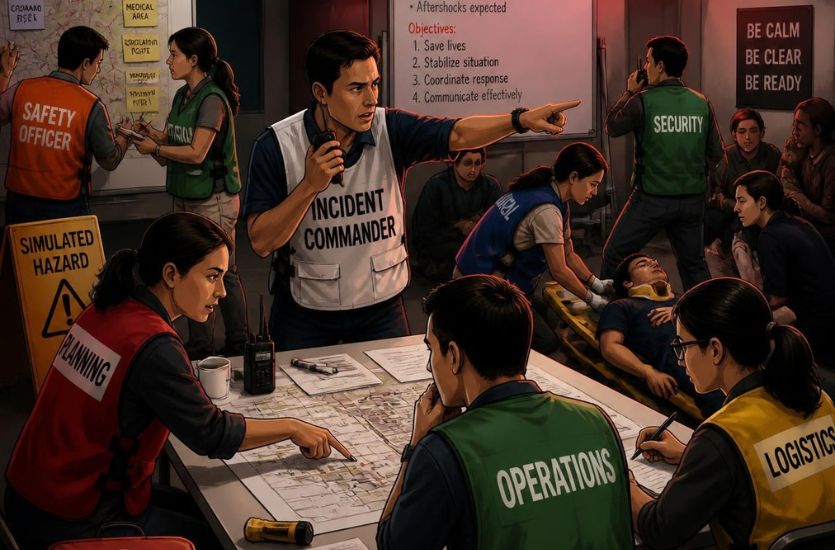
Emergencies happen. You don’t necessarily know how, what, when, where, or even why, but they do. And when they happen, you and your team need to react. But what steps have you taken to prepare?
Having an emergency plan is a start. But we have a bigger question. Is your plan designed to hold up when people are under pressure, systems go down, or normal lines of communication are unavailable?
A tabletop exercise gives your team a chance to work through those situations before they happen. By talking through a realistic scenario, you can identify weak spots, clarify responsibilities, and see where communication may break down. It’s a simple way to test your response plan without staging a full emergency drill.
Quick Answer: What is a Tabletop Exercise?
A tabletop exercise, or TTX, is a role-playing activity in which participants respond to an emergency scenario presented by one or more facilitators. Instead of physically carrying out the response, participants talk through what they would do, who they would contact, and what resources or systems they would use.
The people involved will depend on the organization and the scenario. Participants may include emergency managers, security teams, administrators, IT staff, facilities personnel, dispatchers, first responders, and other department leaders. A facilitator guides the discussion, introduces new developments, and asks questions that encourage participants to think through their decisions.
The goal of a tabletop exercise is to test the organization’s plans and identify gaps before a real emergency tests them.
Tabletop Exercise vs. Drill vs. Full-Scale Exercise
Think about how actors prepare for a scene. They usually begin with a table read, where everyone sits together and works through the script. Next comes blocking, where actors practice where to stand, move, and interact. Rehearsals follow, and eventually the full scene is performed with all the moving parts in place.
Emergency exercises follow a similar progression.
| Exercise Type | Purpose | What Participants Do |
| Tabletop exercise | Review plans and decision-making | Talk through a realistic emergency, discuss responsibilities, and identify gaps. |
| Drill | Practice one specific response | Carry out a focused task, such as a lockdown, evacuation, radio check, or emergency notification. |
| Full-scale exercise | Test a complete response | Respond to a simulated emergency using multiple teams, equipment, communications systems, and field operations. |
FEMA’s HSEEP (Homeland Security Exercise and Evaluation Program) framework places tabletop exercises on the discussion-based side of the exercise continuum. Drills and full-scale exercises are operations-based. As exercises become more complex, they require more planning, personnel, and resources.
That is what makes a tabletop exercise such a no-brainer and a great place to start. An organization can uncover communication gaps, unclear responsibilities, and weak procedures without coordinating a large exercise or interrupting normal operations for an entire day.
Why FEMA HSEEP Should Guide Your Tabletop Exercise
If you’re going to run a tabletop exercise, it helps to have an established framework behind it. HSEEP, as we mentioned earlier, can be very helpful.
HSEEP provides a common approach for planning, conducting, reviewing, and following up on exercises. Rather than simply gathering people in a room and talking through an emergency, the framework encourages organizations to move through four main stages:
- Design and development: Set clear objectives, choose a realistic scenario, and decide what you want participants to work through.
- Conduct: Run the exercise, present the scenario, guide the discussion, and introduce new information as it unfolds.
- Evaluation: Review how participants responded and identify gaps, strengths, and areas that need attention.
- Improvement planning: Document what needs to change, assign follow-up tasks, and decide what to test again.
FEMA also provides templates and resources to support facilitator guides, situation manuals, evaluation plans, exercise plans, and after-action reports.
That does not mean every emergency tabletop exercise needs to become a complicated event. Organizations can adapt HSEEP to fit their own size, risks, staff, and available time while still following a proven process.
You Can Run a Useful Tabletop Exercise in a Couple of Hours
We know how challenging it can be to take critical staff members away from their daily duties. However, the time it takes to run a tabletop exercise will be well worth it, especially if an emergency does arise. And thankfully, these exercises don’t need to take all day.
A focused session can often be completed in just a couple of hours. Start by keeping the process simple and focused on one clear purpose.
- Choose One Clear Objective
Before creating a scenario, decide what you actually want to test. Your objective should be specific enough to keep the discussion focused. You might ask whether leadership can communicate during an extended outage, whether security can reach employees across a campus, or whether dispatch can continue working when network services are unavailable.
You could also test whether different departments can communicate clearly during the same incident. A strong objective gives everyone a common problem to work through and makes the results easier to evaluate afterward.
- Select a Facilitator
Next, choose someone to guide the discussion. Here is what the facilitator does:
- Presents the scenario
- Asks questions
- Introduces new information
- Keeps participants focused on the exercise objective
This person should also prevent the conversation from drifting too far into unrelated issues. FEMA notes that facilitators keep discussions focused on the exercise objectives and explore issues within the time available. The facilitator does not need to have every answer. Their role is to keep participants thinking, talking, and working through the scenario from start to finish.
- Create a Realistic Scenario
The scenario should feel believable to the people in the room. Choose an event your organization could realistically face based on its location, facilities, operations, and daily risks. A coastal organization might prepare for a hurricane. A school or hospital may focus on an active threat.
A public safety agency could test what happens during a network outage. The more familiar the situation feels, the easier it is for participants to picture how they would respond and identify where current plans may fall short.
- Add Injects
An inject is a new piece of information introduced while the exercise is underway. It changes the situation and forces participants to rethink their original response. For example, the backup generator may fail, a second building could lose radio coverage, 911 lines may become overloaded, or the camera network could go offline.
At a school, parents might begin arriving unexpectedly. Cell service could also become unreliable. FEMA exercise materials use injects to move scenarios forward and introduce new conditions, which helps make the discussion more realistic.
- Document the Gaps
The exercise should end with a clear record of what did not work as expected. Note unclear responsibilities, communication failures, equipment limits, delays, and assumptions that proved wrong. Maybe staff members were unsure who should make a decision. Perhaps one department could not reach another.
You may also uncover limits in radio coverage, dispatch systems, video access, or backup power. Documenting these gaps gives your organization a starting point for updating procedures, assigning follow-up tasks, and preparing for future exercises.
Three Tabletop Exercise Scenarios Every Organization Should Consider
One challenge some organizations face is deciding which scenarios to focus on. That said, the best tabletop exercise scenarios are those that your organization might actually face. For example, in Florida, we’re always at risk of hurricanes. In recent years, schools across the U.S. have faced real-life active shooters. And we all know that cybersecurity is a real threat for businesses of all sizes. Creating tabletop exercises based on these three scenarios is the perfect place to start.
- Hurricane With Extended Power Loss
Imagine a hurricane has moved through your area and knocked out commercial power for 24 to 48 hours. Your building is running on backup power, but internet service is unreliable, and some employees cannot reach their supervisors.
Then, halfway through the exercise, introduce an inject: the generator supporting one part of the facility fails. Ask how long radio batteries will last, whether charging stations still work, and whether teams in separate buildings can communicate.
You can also test what happens if video feeds drop, cellular service becomes unstable, or dispatch has to operate with limited systems.
- Active Threat at a School or Hospital
For this scenario, start with a report of a possible armed person inside or near the building. Then add conflicting information about the person’s location. Ask how staff are warned, who initiates a lockdown, and how security communicates with administrators and first responders.
Add an inject where multiple employees call dispatch at once, creating confusion. Another inject could involve a camera spotting someone who matches the description in a different part of the building.
The exercise should test whether security, leadership, staff, and responding agencies can share accurate information quickly and whether communication gaps appear between departments or locations.
- Network Outage That Takes Down Cameras and Dispatch
Start with a sudden network outage that takes video surveillance, computer-aided dispatch, and VoIP phones offline. Then ask what communication tools remain available and whether teams know how to use them.
Add an inject where mobile data terminals also lose connectivity while a separate incident is unfolding. Can dispatch still coordinate field personnel by radio? Can security continue monitoring the facility without camera access? Does everyone know the fallback procedure?
This scenario can reveal how much your emergency response depends on one network and whether radio communications, backup systems, and manual procedures can keep operations moving.
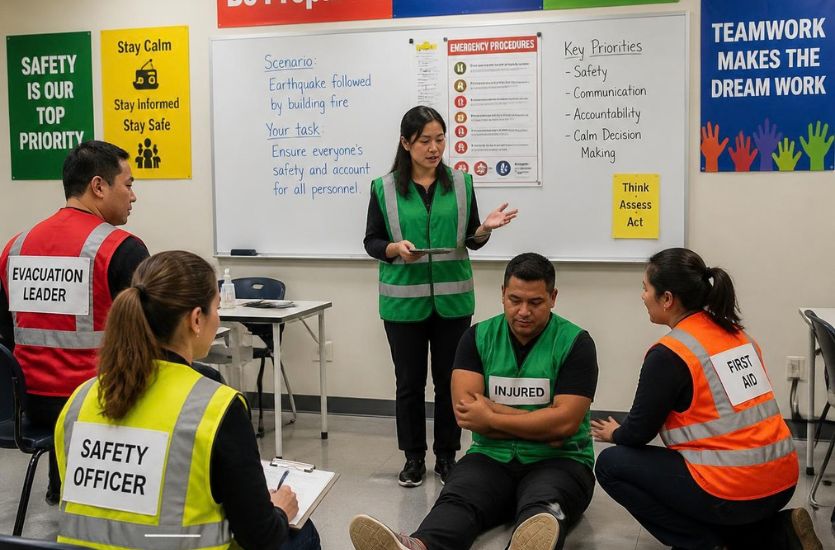
Tabletop Exercises Expose the Who Can Reach Whom Gap
One of the biggest lessons from September 11, 2001, was how quickly communication problems can complicate an emergency response. The 9/11 Commission documented overloaded radio channels, difficulty communicating inside high-rise buildings, and problems sharing information between responding agencies. In some cases, evacuation messages did not reach everyone who needed them.
That is why communication should be part of every tabletop exercise. As the scenario unfolds, ask questions such as:
- Can security talk directly with facilities and leadership?
- Can dispatch reach field personnel if the network goes down?
- Can first responders communicate with people inside the building?
- Are there radio dead zones or areas with weak coverage?
- Who receives video or access-control alerts?
- What happens if cellular service or internet access fails?
- Do employees know which backup channel or system to use?
A tabletop may start as a hurricane, active threat, or network outage exercise. But it often reveals the same underlying problem: people need a reliable way to reach one another when normal communications are disrupted.
Bring Your Communications Partner to the Table
Your emergency managers, security team, IT staff, administrators, and first responders may all have a seat at the table. Your communications partner should, too.
That is where our team at EMCI Wireless can add exponential value. When customers invite our team to participate in a tabletop exercise, we can explain how their current radio and video systems are expected to perform under the conditions being discussed. We can also point out where those systems have limits.
For example, we can help answer questions about radio coverage, battery life, dispatch capabilities, video access, network dependencies, and communication between departments or locations. We can also clarify what happens if one system goes offline or if normal communication channels become unavailable.
That input can help separate assumptions from reality. It is much better to uncover a coverage gap, system dependency, or communication limitation during a tabletop exercise than during an actual emergency.
A Tabletop Exercise Is Only Useful If You Act on What You Find
Let’s address the proverbial elephant in the room: What happens after the tabletop exercise? Does everyone just go back to work and that’s that? Or is anyone actually paying attention to what was learned and taking the steps to apply those learnings to the existing emergency procedures?
That follow-up need to be a significant priority for your business. FEMA’s HSEEP framework includes evaluation and improvement planning for a reason. Your team should document what worked, what didn’t, who is responsible for changes, and when those changes should happen.
That might mean updating emergency plans, fixing radio coverage gaps, revising contact procedures, adding backup communications, or scheduling another exercise.
EMCI Wireless can help here, too. If your tabletop exercise exposes limitations in your radio, video, dispatch, or communications systems, our team can help you understand your options and prepare for the next emergency.
Contact us today and include us in your emergency preparedness planning. Whether you invite us to participate in your tabletop exercise scenarios or bring us in after the fact, we’re here to help your organization be on its game if and when an emergency strikes.