
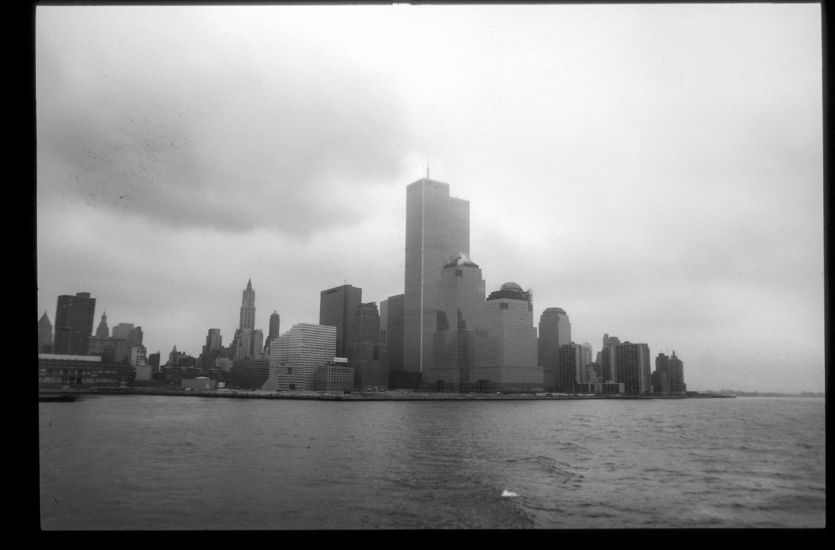
Do you know where you were the morning of September 11, 2001? If you are like many people, you know not only where you were, but exactly what you were doing when news of the first plane hitting the North Tower of the World Trade Center occurred at 8:46 a.m. Eastern Time. We won’t deny the horror and despair that gripped our country, especially when we learned that the attacks did not end with that first plane.
But for those who work in public safety communications, another memory took hold in the aftermath. It was an understanding that people who ran toward those buildings could not talk to each other. That was not a small footnote to the day. It changed what happened inside the towers.
Twenty-five years on, it is worth going back and looking at that plainly. Not to relive it, but because almost everything our industry has built since then traces back to it.
What Happened on the Radios
The 9/11 Commission spent a long time reconstructing the response at the World Trade Center. Chapter 9 of its report, titled “Heroism and Horror,” lays out the communication breakdowns in detail. It is difficult reading. It is also the clearest account we have.
The Fire Department and the Police Department ran separate radio systems. They set up separate command posts. No unified command tied them together. The Commission found that information that mattered for decisions to be made was not shared between the agencies on the scene.
When the South Tower came down at 9:59, the two agencies handled the next 29 minutes very differently.
On the police side, an ESU officer at a command post two blocks away had watched the South Tower fall. By 10:00, he ordered every ESU unit out of the complex, and he told them why. The Commission found that the ESU teams inside the North Tower clearly heard his instruction. One team on the 31st floor found it so hard to believe that they radioed back and asked him to say it again. He repeated it.
On the fire side, it went differently. A chief evacuating the North Tower lobby put out an order within a minute of the collapse, telling all units in Tower 1 to leave the building. Another chief followed with a second order on tactical channel 1. Neither of them yet knew that the South Tower had fully collapsed, so most of the evacuation orders never said so.
Then the messages had to reach people, and for many firefighters they did not. The Commission listed four reasons.
- Some radios did not pick up the transmission, because radio signals struggle in a high-rise.
- Tactical 1 was swamped by the number of units trying to use it at once.
- Some firefighters had no radio at all, or were on the wrong channel.
- Others had been sent over to the South Tower earlier and were on that tower’s channel instead.
The report states it flatly. Some FDNY personnel did not hear the evacuation order on their radios. They found out because other firefighters and police officers who were already leaving told them out loud, face to face, on the stairs.
Some got the word and kept working anyway, staying behind to help civilians who could not walk down on their own. That was a choice, and it deserves to be described as one.
Communication Breakdowns on 9/11 Weren’t Just Because of the Equipment
Two more findings from that morning are rarely discussed in our industry.
The first involves the helicopters. NYPD aviation had a view nobody else had. At 9:51 a pilot warned that large pieces of the South Tower looked like they were about to fall. After it collapsed, a pilot reported that too. More warnings about the condition of the North Tower followed at 10:08, 10:15, and 10:22. Fire chiefs could not hear any of it. The Commission wrote that those chiefs would have benefited greatly from being able to talk to someone in a helicopter.
The Commission was also careful here, and we should be too. It noted that no police helicopter predicted either tower would fall before the South Tower actually came down. The report cautions against overstating what that missing information would have changed.
The second finding is harder. As the ESU team came down stairwell B, they passed firefighters who were resting and told them to get out. Sometimes they got no response. One ESU officer believed some firefighters were not going to take an order from a cop that morning, and at least one firefighter later said the same thing about himself. Another firefighter said ESU ran past him without telling him anything.
Put those two findings together, and you get what still shapes this work. Part of the problem was radios. Part of it was that two organizations had never trained together, never planned together, and did not have a habit of trusting each other’s information under pressure. A patch between two systems does not fix the second part.
The Commission made the same point about scale. The inability to communicate showed up at the World Trade Center, at the Pentagon, and at the crash site in Somerset County, Pennsylvania: three very different places, one repeated failure.
After 9/11, the Communications Industry Started a Case for Change
The response over the last two decades has been real. It has also been slower and less complete than most people outside the field assume.
P25
Project 25 predates 2001. It started in 1989 as a joint effort between APCO, state technology directors, and federal agencies, and the goal was clear. Radios built by different manufacturers should be able to work on the same system and talk to each other. Before P25, buying a radio system often meant getting locked into one vendor’s proprietary design, and a neighboring agency that bought from someone else was simply out of reach.
After 2001, federal grant money accelerated adoption like nothing before. Agencies applying for homeland security funding were pushed toward P25 compliance, and the standard moved from a good idea to the default. Today P25 is what most public safety agencies in the U.S. are running or moving toward.
If you want the practical differences between P25 and other digital standards, we covered that in our comparison of P25 and DMR.
Regional Shared Systems
The second change was structural rather than technical. Instead of every city and county building and paying for its own radio system, agencies began joining shared regional systems. One system, many agencies, common channels and talkgroups already in place before anything goes wrong.
This is the part that has moved unevenly. Shared systems have been built and expanded in many regions, and they work. In other places, agencies that sit ten miles apart still operate separately for reasons that are usually about money, governance, and timing rather than technology. Progress here is real, and it is not finished. Anyone who tells you the interoperability problem has been solved has not spent much time on the funding side of it.
Mutual Aid Channels
A quieter change, and a useful one. A set of nationwide interoperability channels was designated across VHF, UHF, and the 700 and 800 MHz bands, with names like VCALL10, UTAC41, and 8TAC91. These are common ground. Any agency can program them, and CISA publishes a field guide so responders can find the right one under pressure. It is not elegant, and it does the job. When an agency shows up somewhere it has never worked before, these channels give everyone a place to meet. We have written more about how this fits together in our post on interoperability in emergency communications.
FirstNet
The Commission recommended in 2004 that Congress move faster on assigning radio spectrum for public safety (p. 397). It took eight more years. The Middle Class Tax Relief and Job Creation Act of 2012 created the First Responder Network Authority, set aside 20 MHz of spectrum known as Band 14, and put $7 billion behind it. AT&T was selected as the build partner in 2017. The network now reaches all 50 states, the District of Columbia, and five territories.
FirstNet is a broadband network, not a replacement for land mobile radio. It carries data, video, and location information, with priority for public safety traffic when commercial networks are congested. It is also still being shaped. The FirstNet Authority faces a statutory sunset in February 2027, and reauthorization has been working its way through Congress this year.

The Definition of Interoperability Has Changed
In 2001, interoperability meant radios talking to radios. If a deputy and a firefighter could hear each other, the problem was solved.
That definition is too small now. The information that determines how a call goes is no longer just voice.
- It is video. A responder heading to a school wants to know what the cameras inside are showing before the door opens.
- It is license plate data. A plate hit on a vehicle tied to an incident is useful to the officer arriving, not just to the analyst who reads about it later.
- It is access control. Which doors are locked, which are propped open, which ones can be released remotely, and who has the ability to do it.
- It is location. Where the units are, where the caller is, where the person who called 911 from inside the building is standing right now.
None of that moves over a radio channel. It moves over networks, video management systems, access control platforms, and dispatch software. Different companies built those products at different times. They weren’t designed with the expectation that they would one day need to share information.
So the gap has shifted. It is usually not the radio anymore. It is the systems around the radio that were never designed to share. It is also plans that look reasonable on paper but have never been run as an exercise with actual people.
Across the Public and Private Line
There is one more piece, and the Commission saw it coming in 2004.
In the same set of recommendations, the report pointed out that the private sector controls most of the infrastructure in this country. Then it made another observation. Unless the target is a military or secure government site, the report said, the “first” first responders will almost certainly be civilians.
And that’s just the reality. Think of a car accident. The people closest to the accident are other drivers or people in the area. Those people don’t likely work for a public agency.
Consider these other examples.
- A hospital security team is often managing a situation for several minutes before officers arrive. It needs a path to those officers that does not run through a phone tree.
- A school has cameras and door status that would tell the responding agency what it is walking into. Whether that information can actually get there is a question of design, agreements, and practice.
- A manufacturing plant has its own emergency response staff and its own radio system. It may also be the only party who knows what is stored in the building that is now on fire.
- A resort property covers a lot of ground with a small team, is responsible for thousands of guests who do not know the layout, and often sits outside dense coverage.
In each case the private organization knows something first. In each case the public agency has the authority and the resources. The line between them is where information gets stuck, and it is a harder problem than radio interoperability because it involves policy, liability, and trust as much as equipment.
Twenty-five Years After the Attacks
The work since 2001 has been substantial, to say the least. P25 gave agencies a common standard. Regional systems put neighbors on the same infrastructure. Mutual aid channels gave everyone a place to meet. FirstNet built a broadband network for responders that did not exist before.
None of it finished the job, because the job kept getting larger.
What has not changed is the underlying question, and it is the same one the Commission was trying to answer in Chapter 9. When something goes wrong, can the right information reach the right person in time?
On September 11, 2001, for a lot of people in a stairwell in the North Tower, the answer was no.
That is the reason any of this exists. To everyone reading this who answers the call, thank you.