

Hospitals are where we go to get well. When we arrive, we expect to leave in better condition than when we arrived. And the last thing we expect is for that facility to become the scene of a crime.
But on October 22, 2026, tragedy struck Centerpoint Medical Center in Independence, Missouri, when a woman visiting a patient was fatally shot. Her boyfriend, the patient she was visiting, was subsequently arrested and charged with murder.
Unfortunately, this heartbreaking incident is far from isolated. Hospitals and medical centers across the country have experienced a troubling rise in violence, putting patients, visitors, nurses, doctors, and other healthcare workers at risk.
When tensions turn threatening, every second matters. And for hospital staff, getting help isn’t always as simple as picking up the phone. That’s where a hospital panic button or duress alarm system can potentially mean the difference between life or death. This technology gives employees a discreet way to alert security and request assistance when they need it most.
Why Workplace Violence Prevention in Healthcare Demands More Attention
Unfortunately, violence in hospitals isn’t limited to the occasional headline-making tragedy. Nurses and other healthcare workers aren’t immune to verbal threats, physical aggression, and even assaults from patients and visitors. These incidents can happen anywhere, from busy emergency departments and patient rooms to waiting areas and hospital hallways.
And the numbers paint a troubling picture. A 2025–2026 survey by National Nurses United shares that 84.8% of responding nurses experienced at least one form of workplace violence during the previous year. Meanwhile, 36.4% reported that violence had increased on their units.
Beyond the risk of physical injury, these encounters can leave healthcare professionals feeling anxious, fearful, and distracted from providing patient care.
Recognizing the seriousness of workplace violence prevention in healthcare, The Joint Commission introduced new standards for accredited hospitals in January 2022. These requirements address violence prevention programs, incident reporting, risk assessments, staff training, and leadership responsibilities.
For hospital administrators and security directors, protecting employees means taking a proactive approach. That includes giving staff the training, communication tools, and emergency alert technology they need to request assistance when situations become dangerous.
What Is a Hospital Panic Button, and How Does It Work?
So, this begs some questions. What is a hospital panic button? How does it work? Who can access it? And can it really save lives?
A hospital panic button is a device or mobile application that allows healthcare employees to quickly and quietly request help when they feel threatened or face an emergency. Depending on the system, nurses may wear panic buttons, security personnel may carry them, nursing stations may be equipped with them, or staff may access them through smartphones.
Here’s how a typical duress alarm system works.
- An employee activates the alarm. A staff member presses a button or triggers an emergency alert when a situation becomes threatening.
- Security receives the alert. The system notifies hospital security or other designated responders.
- The employee’s location is identified. Depending on the technology, the alert may provide the employee’s location so responders know where to go.
- Help is dispatched. Security personnel assess the situation and send assistance to the affected area.
While no technology can prevent every violent incident, a hospital panic button can help employees summon assistance faster, potentially preventing injuries and saving lives.
Four Types of Duress Alarm Technology for Hospital Staff
Not every hospital employee faces the same risks or works in the same environment. A nurse checking in on patients in different rooms doesn’t have the same communication needs as a security officer patrolling the emergency department or a receptionist stationed at the front desk.
Thankfully, hospitals have several options when choosing a duress alarm system. Here are four technologies worth considering.
1. Wearable Duress Buttons
Wearable duress buttons are small devices that employees can attach to a badge, lanyard, belt, or uniform. They allow staff members to discreetly request assistance without reaching for a phone or leaving the area.
These devices are particularly useful for nurses, behavioral health professionals, and others who regularly move between patient rooms and departments. Depending on the system, pressing the button can alert security and share the employee’s location.
Hospitals should consider battery life, ease of activation, and wireless coverage when evaluating wearable devices.
2. Two-Way Radios With Dedicated Emergency Buttons
Many Motorola Solutions two-way radios feature programmable emergency buttons that allow users to send an alert with a single press. Depending on the radio system, the alert can notify dispatchers or other designated personnel that assistance is needed.
These radios are particularly useful for hospital security officers who already rely on push-to-talk communication. Once an emergency alert is received, security teams can communicate, coordinate their response, and provide updates as they approach the scene.
3. Mobile App Panic Alerts
Mobile panic button applications allow authorized hospital employees to request assistance using their smartphones or other compatible devices. Depending on the application, an alert can notify hospital security, designated staff members, or emergency responders.
Some applications also allow employees to share incident details or communicate with responders.
Mobile alerts may be a practical choice for employees who already carry hospital-issued smartphones. However, hospitals must consider wireless coverage, phone accessibility, and how easily someone can activate an alert during a threatening encounter.
4. Fixed Panic Buttons at Nursing Stations and Other Work Areas
Fixed panic buttons are installed at designated locations throughout a hospital, such as nursing stations, reception desks, registration areas, and emergency department entrances.
When an employee presses the button, the system alerts hospital security or another designated response team. Because the device is installed in a specific location, responders can identify where the request originated.
Fixed buttons can be especially useful for employees who spend much of their shifts at one workstation. However, they provide less flexibility for staff members who frequently move throughout the hospital.
Why Indoor Location Tracking is Non-Negotiable During a Hospital Emergency
Let’s work through a little example. Imagine that a nurse activates a panic button after a patient becomes physically aggressive. Hospital security receives the alert, but one problem remains. They don’t know where the nurse is located. Is she on the second floor? In the emergency department? Inside a patient room?
Without knowing where she is, precious seconds or even minutes can be lost trying to find her when she really needs help immediately.
This is a prime example of how indoor positioning systems can help. Traditional GPS technology often struggles inside large buildings, especially those with multiple floors, thick walls, and complex layouts. Indoor positioning technology uses tools such as Bluetooth beacons, Wi-Fi access points, and location tags to help identify where someone is located within a facility.
Depending on the system, security personnel may be able to identify the building, floor, department, or even the specific room where an alert originated.
For example, the Motorola Solutions TLK 25 wearable device supports emergency alerts and can provide indoor location information when paired with compatible location technology.
When a hospital panic button is connected to an indoor positioning system, security teams have a much better idea of where to send help. And during a violent encounter, knowing exactly where to go can make all the difference.
Connecting Panic Alerts With Security Dispatch and Video Surveillance
Now we have another question to consider. If your healthcare facility already has security dispatch and video surveillance systems in place, how do panic alerts fit in?
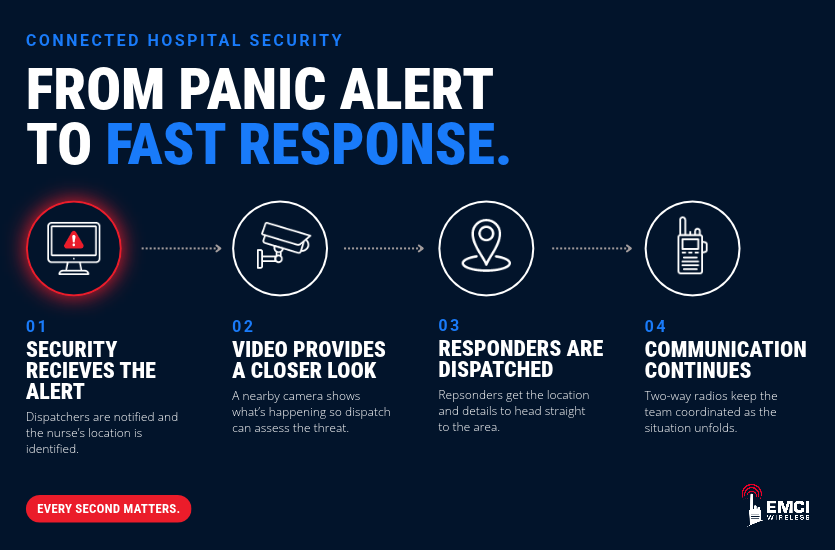
The answer is to connect these technologies so they work together during an emergency. For example, imagine a nurse activates a wearable panic button after a visitor becomes aggressive. With a properly integrated system, here’s what could happen next.
- Security receives the alert. The duress alarm system notifies dispatchers and identifies the nurse’s location.
- Video provides a closer look. Dispatchers access a nearby security camera to see what’s happening and assess the threat.
- Responders are dispatched. Security officers receive the location and other available details, allowing them to head directly to the affected area.
- Communication continues. Two-way radios allow security personnel to coordinate their response and provide updates as the situation unfolds.
For your hospital security team, connecting your technology means you’ll have more information available when an employee calls for help. Instead of spending valuable time piecing together details, your responders can focus on reaching the employee and addressing the threat.
What Should Hospitals Look for in a Duress Alarm System?
There’s no denying that healthcare executives and facility leadership teams want all employees and patients to be kept safe at all times. But to do that, you need to know what to look for in a duress alarm system.
That said, every hospital and medical center has different needs. Here are the factors to consider when evaluating your options.
- Ease of use. Employees should be able to activate an emergency alert quickly, even when they’re frightened, injured, or unable to speak.
- Discreet operation. Look for devices that let staff request help without drawing attention or escalating a threatening situation.
- Accurate location tracking. A system that identifies an employee’s location helps security personnel reach the right area without unnecessary delays.
- Reliable coverage. Make sure the technology works throughout your facility, including stairwells, basements, parking garages, and other areas where wireless signals may be weak.
- System compatibility. Consider whether the duress alarm system can connect with your existing two-way radios, video surveillance, and security dispatch equipment.
- Training and testing. Employees need to understand how to activate alarms, while security teams should regularly practice receiving alerts and responding to incidents.
Before deciding, bring nursing leadership, security directors, and facilities managers into the conversation. Their firsthand knowledge can help identify potential safety gaps and determine which technologies make the most sense for your hospital.
Support Your Hospital’s Staff Safety Program With EMCI Wireless
Though we all wish there were a magical solution to eliminate the threat of workplace violence, it helps to know that certain technologies exist to keep us safe when we need them most.
From wearable panic buttons and two-way radios to indoor location tracking and video surveillance, these solutions can help hospital employees get assistance when they need it most.
At EMCI Wireless, we understand the challenges healthcare facilities face in protecting staff, patients, and visitors. As a Motorola Solutions Channel Partner serving Central and South Florida, we offer communication and security solutions designed to support your hospital’s safety needs.
Whether you’re considering a hospital panic button, upgrading your existing duress alarm system, or looking for ways to connect your security technologies, we’re here to help.
Contact EMCI Wireless today to discuss your facility’s needs and take the next step toward a safer hospital environment.